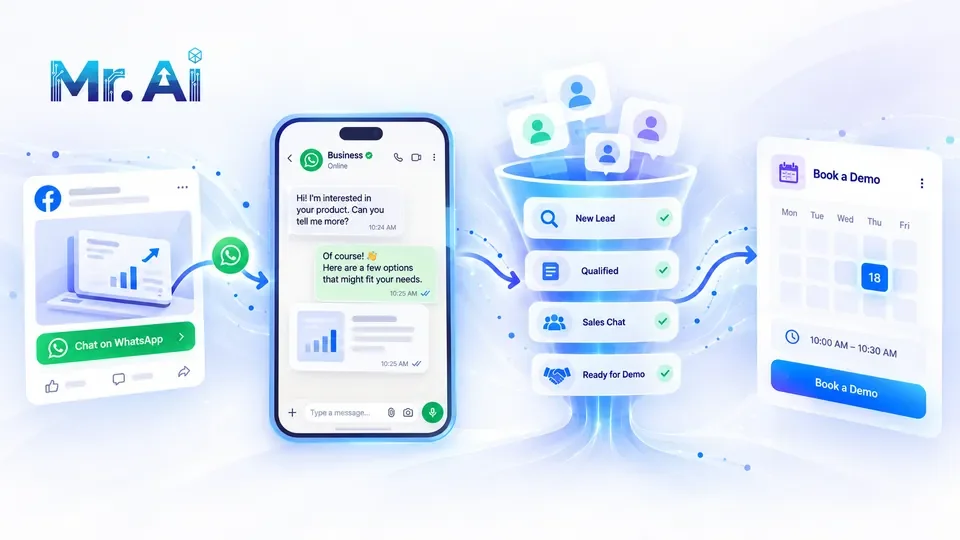
If your ads generate plenty of WhatsApp messages but most people ask for a service you do not offer, a price that does not exist, or a location outside your coverage, do not increase the budget before comparing what the ad promised with what the customer expected when they opened the conversation.
Targeting may be too broad. But sometimes the real problem is simpler: the ad led people to expect something the business cannot deliver. In other cases the ad is accurate and the first inbox response loses an otherwise suitable prospect. This is a joint marketing and sales diagnosis, not a quick verdict that the leads are bad.
Compare the ad promise with the first message
Imagine an industrial maintenance company serving factories in Cairo and Giza only. Its ad says “maintenance solutions for factories” without naming its service area or supported equipment. Inquiries then arrive from other governorates or about equipment it does not maintain. This is a hypothetical example, not a real customer case.
Place three things side by side: the exact ad creative and copy, the prospect's first actual question, and the team's first response. If the ad omitted a decisive condition, the prospect cannot be expected to guess it. If the condition was clear but the reply ignored it, fix the reply before changing the audience.
This is different from calculating the cost of a qualified lead. Our qualified lead cost guide explains the metric. Here the question is which part of the experience needs changing.
Four problems that should not be confused
An unclear advertising promise: The creative says “prices from” without explaining the offer's boundaries, or presents a wider service scope than the business can provide. The response is to clarify the copy, visual and essential conditions.
An unsuitable audience: The promise is clear, but inquiries consistently come from regions or customer groups outside the service scope. Review campaign settings, placements and available targeting information rather than blaming the inbox team.
Poor conversation qualification: A suitable buyer is asked a long series of questions before receiving an answer, or is rejected simply because they cannot name a budget yet. Review the response sequence and qualification criteria.
A good opportunity lost after the first exchange: The prospect understands the offer and is a fit, but nobody owns the next step or follow-up. This is an operations problem, not necessarily an advertising problem. See our ad-to-conversation measurement guide.
These four categories are a proposed practical review framework, not Meta's official classification. A single conversation can involve more than one cause, and some causes will remain uncertain.
A seven-day review without a complicated dashboard
Choose one campaign and a fixed window, such as the past seven days. Review all associated conversations if the volume is manageable, or use a documented consecutive sample instead of cherry-picking only the worst ones. Do not copy personal customer details into the audit file.
For each conversation record the date of the first message, the ad or source only when genuinely known, the first question, the requested service, location or eligibility fit, whether the customer received a correct answer, and whether a next step was reached. If the original ad cannot be identified, mark the source as unknown. Never assign a conversation to a campaign by guesswork.
Now review the ad and the reply together. What did the customer need to know before clicking? Was it stated? Which questions keep appearing after the click? Could those questions be answered in the ad, or are they reasonable questions for a conversation?
Not every unsuitable inquiry is an ad failure. Some people are exploring alternatives, and some suitable buyers are not ready to purchase yet.
Decide whether to fix the creative, audience or conversation
If unsuitable prospects repeatedly ask about a critical condition missing from the ad, test a clearer creative that states it. If the message is clear but inquiries arrive from outside the service area, inspect targeting. If suitable prospects disappear after unhelpful replies, improve the approved knowledge and response sequence. If the reply is useful but nobody follows up, assign an owner and a next step.
Change one major variable per test when practical, and keep the original creative and the change date. If you change the copy, targeting and reply simultaneously, you cannot tell which change helped.
Compare cohorts that started conversations in comparable windows, allowing each enough time to be qualified. Monitor the share of suitable conversations, the share reaching a meaningful next step, and cost per qualified opportunity only where spend and attribution are reliable. Small samples do not prove causation; seasonality, offer changes and budget can also affect outcomes.
Google Ads guidance distinguishes qualified leads from converted leads. It is a useful reference for defining measurement stages, not evidence that WhatsApp outcomes are automatically sent to an advertising platform. Meta's January 2026 update discusses growth in its click-to-message business, but its figures concern Meta and specified markets, not a benchmark for lead quality in Egypt.
Where Mr. AI fits, and where it does not
According to the current product information, Mr. AI can help teams answer using company knowledge, follow up on conversations, create summaries, and surface cases needing human judgment. Those functions are relevant when checking whether prospects received accurate information and whether follow-up was organized.
But do not assume the product automatically analyzes every ad creative, captures a Campaign ID for every message, or proves why an ad failed. Ad targeting and spend belong in the marketing tools, while closed sales belong in sales records. Connect only the fields you have actually verified.
Start with one campaign and a short meeting between marketing and sales. Leave with one testable decision: clarify the ad promise, change the audience, improve the first reply, or organize follow-up. That is more useful than raising the budget because cost per message looks low.