The short answer: the ad does not end when WhatsApp opens
If a Facebook or Instagram ad sends a prospect to WhatsApp or Messenger, the number of messages alone does not establish whether the campaign is working.
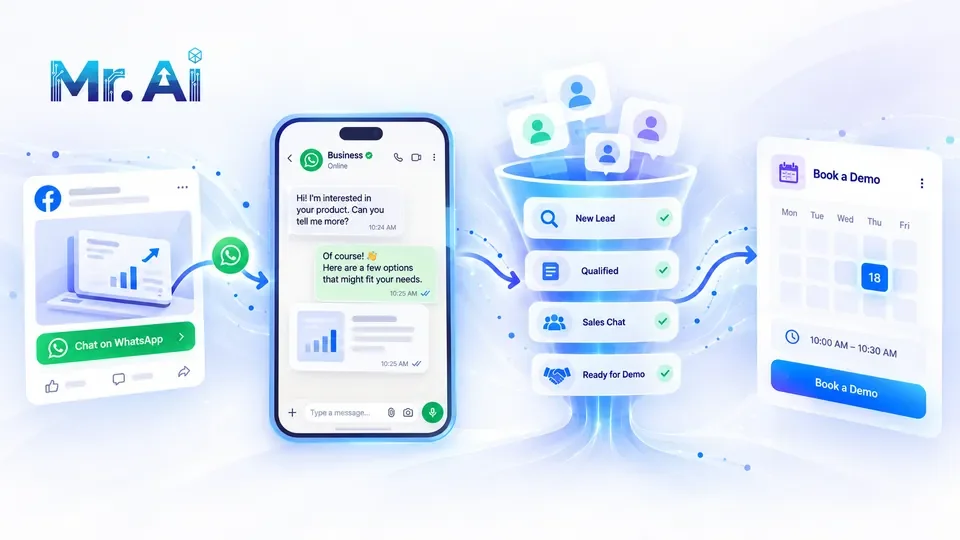
The ad begins a conversation. What happens next is an operating process: did the customer receive a useful answer, did your team understand the need, is there a next step, should a person intervene, and did the conversation lead to a qualified opportunity, booking, order or customer?
A useful Click-to-Message funnel starts with the ad and ends with a business outcome, not simply with a messaging start.
Why Click-to-Message deserves measurement beyond the inbox
In January 2026, Meta reported that US click-to-message ad revenue had grown more than 50% year over year in Q4 2025. It also said paid WhatsApp messaging exceeded a $2 billion annual revenue run rate. Those figures refer to Meta's business and US growth, not an Egyptian advertiser benchmark. Source: Meta, 2026: AI Drives Performance.
A separate February 2026 study published by Meta and the Retailers Association of India reported that participating retailers using Business Messaging and Click-to-WhatsApp saw averages of 62% more leads, 61% better ROAS and 22% higher order values. These were findings from the Indian study sample, not promised or expected outcomes for Egyptian businesses. Source: Meta and Retailers Association of India.
The useful question is not whether your business will replicate those figures. It is what happens after a person moves from an ad into a customer conversation.
A seven-stage Click-to-WhatsApp and Click-to-Messenger funnel
1. Ad click
A click indicates some interest in the message, offer or creative. It does not prove that the person is qualified or has started a meaningful conversation.
2. Conversation started
Count conversations where the person actually initiated an exchange.
Conversation Start Rate = actual conversations started / eligible ad clicks.
Set one consistent definition of a conversation. Opening an app is not the same as sending a message. Keep platform-reported messaging events separate from your operational count.
3. Useful first response
Did the first response help the customer? Compare a generic "How can we help?" with a direct answer to the question in the ad.
Response time matters, but speed alone does not establish quality. HubSpot's lead response time guide discusses the gap between a person's expression of interest and a sales follow-up, including routing and notification delays.
4. Qualified conversation
A message is not automatically a qualified lead. Qualification depends on the business: product fit, geography, budget when relevant, timing, the customer's actual need and evidence of intent.
Conversation-to-Qualified Rate = qualified conversations / actual conversations.
This can reveal whether the ad attracts the wrong audience or a good audience encounters a poor conversation process.
5. Next step reached
A qualified interaction should have a visible next step: book a demo, visit the branch, request a quotation, select an appointment, receive a payment link, speak with sales or supply missing details.
A conversation without a next step is not necessarily a lost lead. It does, however, need a clear status so it does not disappear from the inbox.
6. Follow-up
Some customers will not decide in the first exchange.
Follow-up Coverage = eligible cases actually followed up / cases due for follow-up.
Follow-up needs context, channel-policy compliance and restraint. A person who says "call me next month" needs a different approach from someone who is still waiting for an answer. See how to follow up without pressuring customers.
7. Business outcome
The outcome might be a booking, qualified sales opportunity, completed order, subscription, store visit or closed sale. Define it in advance before comparing campaigns.
Four metrics that matter more than cost per message alone
Cost per qualified conversation
Advertising spend / qualified conversations.
A hypothetical campaign spends EGP 10,000 and receives 500 messages: EGP 20 per message. If only 100 conversations qualify, the more relevant figure is EGP 100 per qualified conversation.
Cost per next step
Ad spend / targeted next steps completed.
For example, EGP 10,000 divided by 50 booked demos is EGP 200 per booked demo.
Customer acquisition cost
Total acquisition cost / new customers.
Do not use ad spend alone if relevant sales labor, tools or commissions are part of acquisition costs.
Contribution margin after acquisition
Revenue is not profit. If an order is EGP 2,000 and variable costs are EGP 1,400, contribution margin before acquisition cost is EGP 600. Compare acquisition cost against the margin available to cover it, not just the headline revenue.
A hypothetical comparison: the cheaper conversation is not always better
The following numbers are illustrative only, not Mr. AI customer results or Egyptian market benchmarks.
| Metric | Campaign A | Campaign B |
|---|---|---|
| Ad spend | EGP 12,000 | EGP 12,000 |
| Conversations | 800 | 500 |
| Cost per conversation | EGP 15 | EGP 24 |
| Qualified conversations | 120 | 175 |
| Bookings | 45 | 70 |
| New customers | 12 | 20 |
| Cost per qualified conversation | EGP 100 | about EGP 69 |
| Cost per booking | about EGP 267 | about EGP 171 |
| Ad spend per new customer | EGP 1,000 | EGP 600 |
Campaign A appears cheaper if you stop at the message metric. Campaign B produces stronger downstream results within this hypothetical scenario. A real decision also needs comparable margins, acquisition costs, customer quality and attribution.
Attribution is not the same as incrementality
An attributed sale does not prove that the sale would not have happened without the ad. Someone may have already known your brand, or may move between channels before buying.
Meta's March 2026 measurement update describes conversion-lift or incrementality tests as a way to estimate outcomes caused by advertising rather than just credited to it. Source: Meta, Simplifying Ad Measurement.
A small business may not begin with a sophisticated incrementality study. It can still distinguish what Ads Manager attributes, what the sales team actually records, and what can confidently be claimed as incremental.
Find the leaks after the ad
Does the first response match the advertised offer?
If the ad promises a free consultation but the reply starts by asking the customer to repeat everything, it creates friction.
Does the responder know the offer's conditions?
The current price, eligibility, schedule, exclusions and promised next step should be available to anyone replying, human or AI.
Is campaign context available?
When possible, preserve what interested the prospect. Do not force the customer to restart the journey.
Can you identify qualified opportunities?
If your team cannot answer "which conversations were genuine opportunities?", you cannot assess targeting quality from message counts.
Are eligible customers followed up appropriately?
A paid-for inbound lead should not silently disappear after one unanswered question, but follow-up must respect customer preferences and channel rules.
How AI fits into the funnel
In June 2026, Meta described its Business Agent as a system that could answer company questions, recommend catalog items, book appointments, qualify leads and let businesses set intervention points for employees. Source: Meta Business Agent.
No AI tool removes the need for measurement or human oversight. Ask where responses get their information, which cases lack an answer, when escalation happens, what needs follow-up and what the next step is.
Where Mr. AI fits
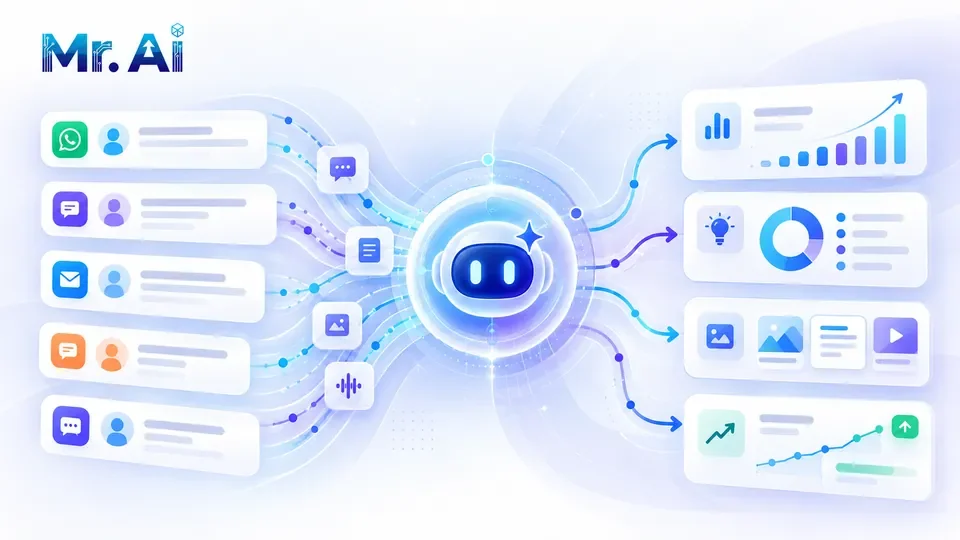
According to the website's current product information, Mr. AI works with WhatsApp, Facebook Messenger and website chat, and supports replies using company knowledge, automated follow-up, next-step tracking, summaries, AI insight reports, communication analytics and human handoff.
Those capabilities do not guarantee a campaign's conversion rate or ROI. Their role is to help structure and evaluate what happens after a customer enters the conversation. For more context, see business messaging in Egypt as a sales operation.
A practical weekly dashboard
Capture ad spend, clicks, platform-reported messaging starts, actual conversations, useful replies, qualified conversations, completed next steps, follow-ups due and completed, bookings or orders, new customers, revenue, contribution margin and reasons opportunities were lost.
Then compare by campaign, ad set, creative, offer, channel, time of enquiry, question type and lost-opportunity reason.
The decision
If your campaign evaluation stops at cost per message, you only see the beginning of the customer journey.
This week, define three items: qualified conversation, next step, business outcome. Then connect your messaging process to those stages as consistently as possible.
If your business depends on WhatsApp or Messenger enquiries, try the Mr. AI customer experience or book a session to examine what happens after the ad generates a conversation.