
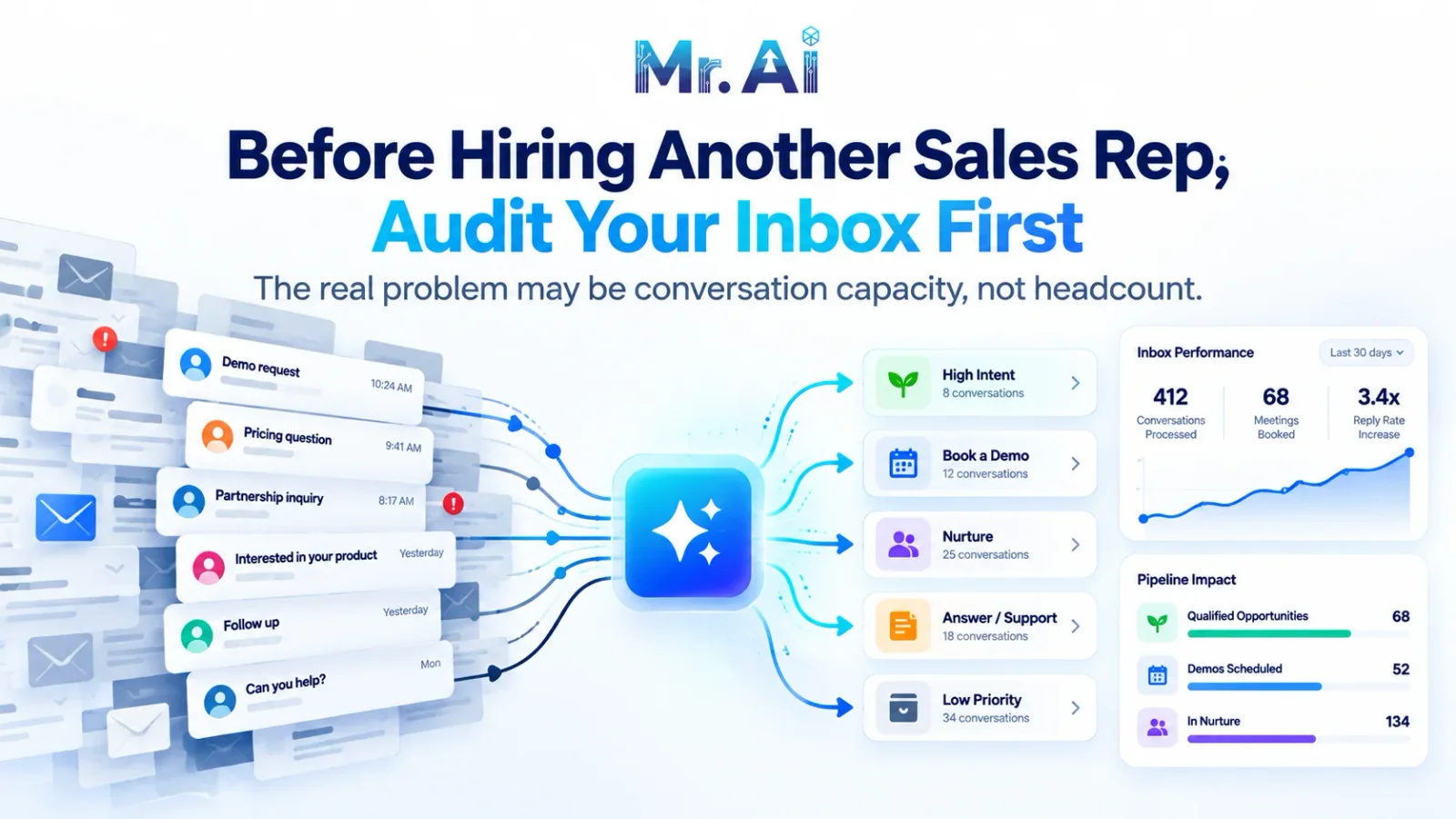
It is 2:30 PM. A campaign is running, 47 conversations are open, and one sales rep is answering the same pricing question for the fifth time. Meanwhile, a lead who was ready to book yesterday is still waiting for a follow-up.
The obvious conclusion is: we need another person.
Sometimes you do. But headcount is a poor fix for a broken workflow. Before opening a role, it is worth separating two very different problems: not enough human capacity and too much human time spent on work that should be organized differently.
Headcount costs more than payroll
A new hire comes with recruiting, onboarding, supervision, tools and shift coordination. More importantly, not every hour of that employee's day is spent on conversations that actually require human judgment.
Microsoft's 2025 Work Trend Index describes a broader Capacity Gap: 53% of leaders surveyed said productivity needs to increase, while 80% of the global workforce said they lack enough time or energy to do their work. Microsoft 365 telemetry also found that workers are interrupted by a meeting, email or notification roughly every two minutes during core work hours.
Source: Microsoft Work Trend Index 2025
Those are global workplace findings, not a benchmark for Egyptian sales teams. But the underlying problem is familiar: fragmented attention consumes capacity before a team gets to its highest-value work.
Salesforce's 2025 State of Service research gives the idea a customer-service lens. Service reps using AI reported spending about 20% less time on routine cases, which Salesforce estimates at roughly four hours per week. That is not a promise that your team will save four hours. It is a reason to measure what your people are doing before deciding how many people you need.
Source: Salesforce State of Service 2025
Audit 200 conversations before you open a job requisition
Pull a real sample from the last two to four weeks. A hundred conversations is useful; two hundred is better.
Do not just count messages. Sort the work into four buckets.
Repeatable work: pricing questions, opening hours, service details, payment methods and recurring FAQs.
Follow-up work: leads that went quiet, people who asked to be contacted later, or conversations that stopped while waiting for one piece of information.
Human-judgment work: negotiation, complaints, exceptions, high-value opportunities and cases where the company does not have a reliable documented answer.
Coordination waste: looking for old context, asking a colleague what happened, duplicating replies, or discovering that everyone assumed someone else owned the next step.
The distribution matters more than the raw inbox volume.
If most of the pressure sits in the third bucket, you may genuinely need more human capacity.
If a large share sits in the first two , plus avoidable coordination waste , adding another person can simply add another person to the same operating problem.
Put a price on the problem, carefully
Use your own recurring cost: salary, commission, recruitment, training, tools and supervision time. Compensation varies by role, experience and industry, so do not treat one salary figure as a universal hiring benchmark.
Mr. AI's current published pricing starts at EGP 1,100 per month for Starter with 1,300 points. The currently verified toolkit includes WhatsApp, Facebook Messenger and website chat; replies grounded in company knowledge; automated follow-up and next-step tracking; conversation summaries; AI insight reports; and communication analytics.
But EGP 1,100 versus an employee's salary is the wrong comparison.
Software and people do different jobs.
A better question is: how many hours of repeatable work can be organized, what will the team do with the capacity that creates, and is there still a human-capacity gap afterwards?
A hypothetical example
Suppose a team spends 60 hours per month on repeat questions and straightforward follow-up.
For illustration only, assume better knowledge, routing and follow-up reduce the manual effort by 25 hours.
If the company's internal value of an hour is EGP 60:
25 × EGP 60 = EGP 1,500 per month in theoretical time value.
That is not EGP 1,500 of cash savings. The employee still works for the company and still gets paid. The value exists only if those hours move to something more useful: qualified leads, calls, closing, difficult cases, or delaying a hire that would otherwise be required.
That is why "hours saved" on its own is an incomplete KPI.
When hiring is still the right answer
Automation should not be an exercise in proving that you do not need people.
Sometimes the analysis should end with: hire.
If repeatable replies are already organized, follow-up is reliable, handoffs are clean, and the team still cannot keep up with calls, negotiation and complex cases, you have found a real capacity problem.
A new hire then joins a healthier operation instead of spending the first month learning where pricing lives, who owns each lead and which conversations were forgotten.
The reverse is also true. If every basic inquiry requires manual work, every follow-up depends on someone's memory, and every handoff starts from zero, headcount can postpone the problem rather than solve it.
The better staffing question
The practical goal is a clear division of work: repeatable questions with approved answers, and cases that need judgment, negotiation or human review. Reducing handoffs is not a goal by itself; each case should reach the right person or workflow.
You do not need to copy an enterprise service model. The useful shift is much simpler.
Instead of asking:
"How many people do we need to answer all these messages?"
Ask:
"Which of these messages actually deserve a person's time?"
That is the operating space Mr. AI is built for. Based on its currently published product information, it can assist with knowledge-based replies, stalled-conversation follow-up, next-step tracking, conversation summaries and visibility into communication. Human judgment remains with the team when a case needs it.
For the financial side, see the conversation automation ROI framework. If handoff is the bigger issue, read when AI should hand a sales conversation to a person.
Run this test before your next hiring decision
For one week, track five things: incoming conversations, repeatable questions, missed follow-ups, cases that truly required human judgment, and time spent rebuilding context.
Then ask one question: if the repeatable work and coordination waste were better organized, would the team still be overloaded?
If yes, you have much stronger evidence that another hire is justified.
If no, you found something more useful than a theoretical "headcount saving": you found where your current team's time was disappearing.
You can start with Mr. AI using your own workflow, or book a demo to discuss the use case with the team.