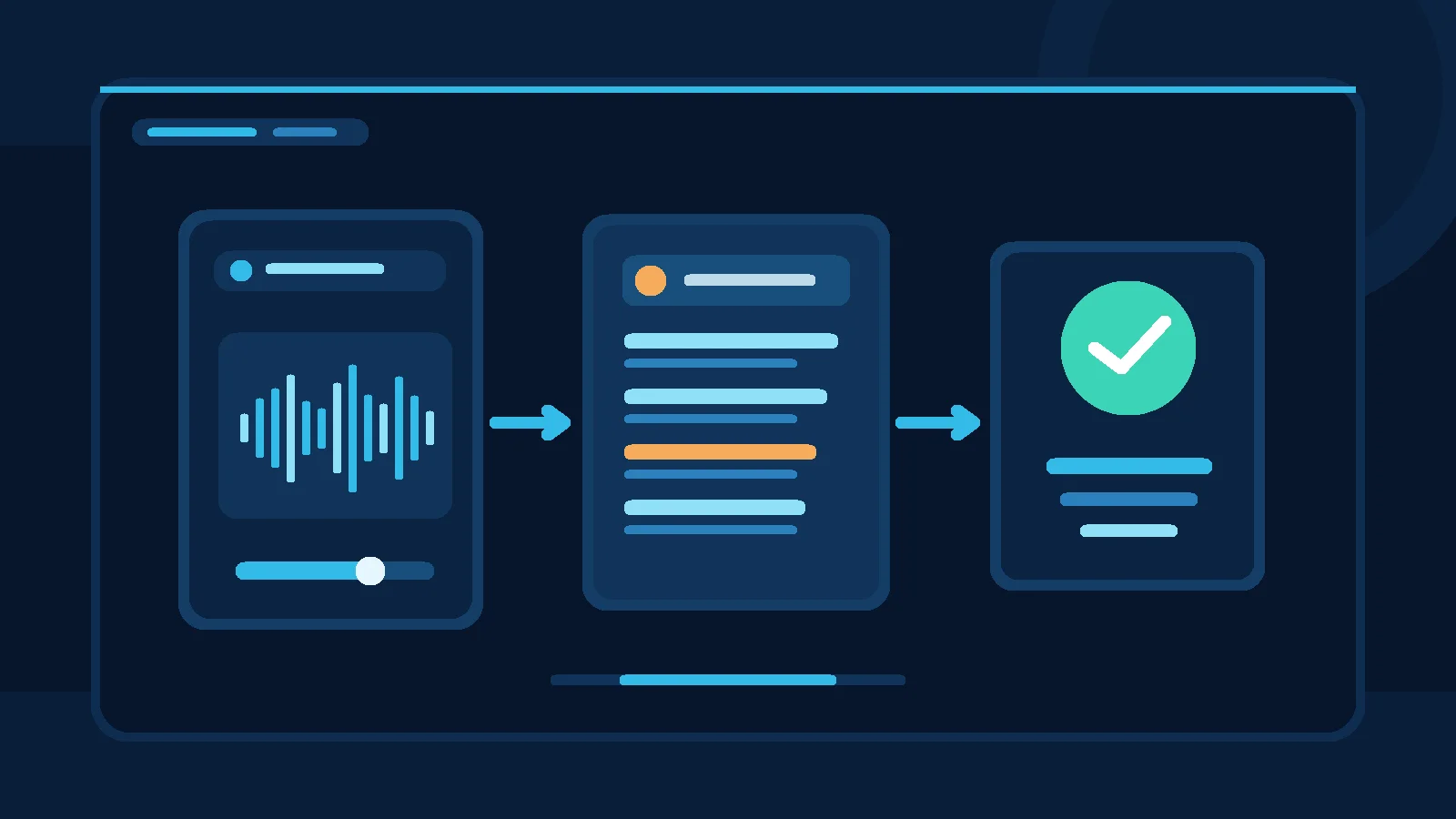
A customer sends a three-minute voice note instead of typing a request. The real problem is not its length. It is the one detail that changes the order, delivery date or service scope. Treat audio as input to understand, not as an instruction to execute before confirmation.
Capture the request, not necessarily every word
Imagine a shop owner saying, “I need the same quantity as last time, but in another color, delivered before Thursday.” A team member who records only “repeat previous order” has missed the decision-critical change.
A useful intake record contains the customer, channel, request type, confirmed facts, uncertain facts and the person responsible for the next step. A full transcript may be useful, but it is not a substitute for understanding the requested action.
Speech-to-text is a draft, not verified evidence
Automatic transcription can speed up review, yet names, quantities, Egyptian Arabic, background noise and similar-sounding numbers can produce mistakes. Keep a clear distinction between what software inferred and what the customer explicitly confirmed. We are not claiming that Mr. AI includes automatic voice transcription.
For example, a transcription error between fifteen and fifty units can change the commercial commitment. Confirm quantities, money, dates and other consequential details with the customer. If the recording is unclear, ask for the specific information in writing instead of guessing.
The UK Information Commissioner's Office guidance on AI and data accuracy explains the importance of distinguishing factual data from inferred outputs. It offers a useful general principle, not an assertion about Egyptian legal requirements.
A reply that proves you understood
Rather than “Noted,” a better response would be: “I understand you want the same product in a different color and delivery before Thursday. Could you confirm the color and quantity so we can check availability?” This is an illustrative example, not a real customer exchange.
When a recording contains several requests, separate what needs a decision now from what can wait. If the customer asks for a person or raises a sensitive complaint, hand over the conversation with a concise summary. Our guide to AI-to-human handoff explains when escalation matters.
Protect the recording and the customer
Audio may contain personal information the team does not need. Do not ask customers to record full payment-card or identity numbers. Limit access to recordings and transcripts, disclose relevant processing and external transcription services, and apply your retention policy and applicable law.
The WhatsApp Business Messaging Policy, updated September 23, 2026, emphasizes appropriate permissions, data protection and clear human escalation options when using automation.
Test before automating the workflow
Review ten anonymized voice notes. Compare the captured details with what customers confirmed, then classify material errors: quantity, product, date, address or complaint reason. If these mistakes are common, fix the process before expanding automation.
According to the current Mr. AI FAQ, the platform supports knowledge-based replies, conversation summaries, follow-up and human takeover. That is not a claim that voice-note transcription or automatic audio listening is supported. Verify the required message type in your own account. You can book a demo to walk through your actual intake workflow.