A customer asks: “Am I talking to someone on your team, or is this AI?”
That question should not put your business in an awkward position.
The worst approach is to make an AI assistant impersonate a human. The second-worst is to bury the customer in a legal disclaimer before they have even asked a question. A better default is much simpler: say that AI is handling the conversation, explain what it can help with, and make the route to a human obvious.
This is becoming more than a tone-of-voice choice. Since 2 August 2026, Article 50 transparency requirements under the EU AI Act apply to certain interactive AI systems. The European Commission specifically says people interacting directly with chatbots and AI agents should be informed that they are dealing with AI.
Customer research points in the same direction. Salesforce reports that 72% of customers say it is important to know when they are communicating with an AI agent.
Don’t invent a human employee
Imagine opening a customer conversation with:
Hi, I’m Alex from customer support. How can I help?
If “Alex” is actually an AI system, the business has created a trust problem for no practical benefit.
A clearer version can still sound warm:
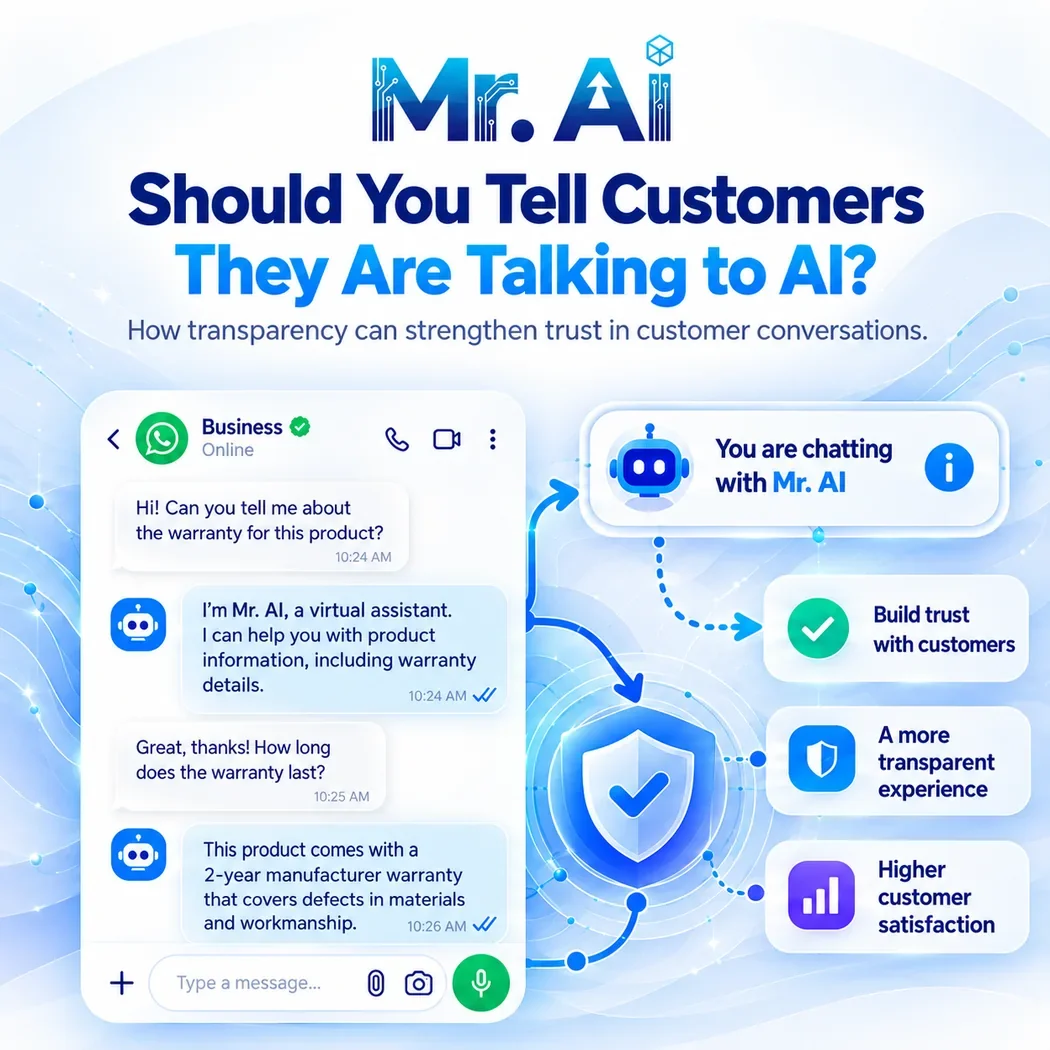
Hi , I’m the company’s AI assistant. I can help with services, pricing and common questions. If you need someone from the team, I can hand the conversation over.
That single message answers three useful questions: who is replying, what the assistant can do, and whether a human is available.
Salesforce’s latest connected-customer research makes the trust issue especially relevant. 61% of customers say advances in AI make trustworthiness more important, while 72% want to know whether they are interacting with an AI agent.
Source: Salesforce , State of the AI Connected Customer
Transparency is not a technical architecture diagram
Customers generally do not need the model name, vector database, context-window size or orchestration stack.
They need operational clarity:
- Is this AI or a person?
- What can it actually do?
- What happens if it does not know the answer?
- How do I reach a human?
- Is a consequential decision being reviewed by someone?
Those boundaries matter because comfort with AI changes with the task. Salesforce found that 46% of business buyers would work with an AI agent to get faster service, while only 17% of customers were comfortable with an agent making financial decisions for them.
A customer may happily ask AI about opening hours and product details, then reasonably want a person involved in a contract exception or financial decision.
Europe has turned the principle into a rule
There is an important distinction between good practice and legal obligation.
The European Commission says Article 50 of the EU AI Act applies from 2 August 2026. Providers of AI systems that interact directly with people , including chatbots, agents and avatars , must design those systems so people are informed that they are interacting with AI.
Official source: European Commission , Article 50 transparency obligations
On 31 July 2026, the Commission also announced the start of enforcement and explicitly stated that chatbots and other interactive AI systems must tell users that they are dealing with AI rather than a human.
Source: European Commission , AI Act enforcement and transparency requirements
That does not mean every Egyptian company automatically falls under EU law. Businesses serving EU users or operating in a way that may bring them into scope should get appropriate legal advice rather than relying on a blog post. But the product-design lesson travels well: customers should not have to discover the use of AI by accident.
The handoff is where transparency gets tested
Disclosure at the start is only half the job.
When a conversation reaches a point that needs human judgment, tell the customer what is happening:
This needs a review from our team. I’ll hand the conversation over so a team member can continue with you.
And when the person joins, make that transition clear too. A silent change in writing style should not be the customer’s only clue.
There is an operational reason to take handoffs seriously. Salesforce’s Agentic Enterprise Index found that human escalations among the businesses it studied increased from 22% in Q1 2025 to 32% in Q2 2025 as agents became better at identifying when human expertise was needed. This is not a universal benchmark, but it makes an important point: better AI does not necessarily mean driving handoffs toward zero.
Source: Salesforce , Agentic Enterprise Index, H1 2025
That principle matches Mr. AI’s currently published product boundaries. Mr. AI can assist with replies based on company knowledge, follow-up and conversation summaries, while decisions and cases requiring human judgment stay with the team. When a handoff is needed, the team can receive the conversation with its history and summary rather than starting blind.
A useful opening message takes three decisions
Before an AI assistant goes live, read its first message and ask:
Does the customer know this is AI?
Do they know what it can help with?
Do they know a human is available when needed?
A retailer might say:
Hi 👋 I’m the store’s AI assistant. I can help with products, prices and order information. If you need someone from the team, just ask and I’ll hand you over.
A clinic needs different boundaries:
Hi, I’m the clinic’s AI assistant. I can help with service information, availability and booking. Medical questions or decisions that require a professional will be passed to the team.
And a B2B company could use:
Hi, I’m the company’s AI assistant. I can answer questions about our services and collect details about what you need. If you want to discuss a proposal or an exception, I can bring in a team member.
The wording is not the important part. The absence of deception is.
Trust beats pretending the AI is human
Zendesk’s CX Trends 2026 research, based on more than 11,000 respondents globally, found that 95% of consumers expect an explanation for AI-made decisions, while 79% say plain-language reasoning is important. The survey did not include Egypt, so these figures should not be treated as Egyptian market benchmarks.
Source: Zendesk CX Trends 2026
The broader lesson is still useful: the more authority AI has in a customer journey, the more important it becomes to explain what it is doing and where human responsibility begins.
So before asking, “How do we make our AI sound more human?”, ask a more important question:
Does the customer know it is AI , and know when a human will step in?
If you are preparing an AI employee for customer conversations, Mr. AI lets you add company knowledge, configure rules and test replies before using them with customers. You can try the customer experience or review pricing before going live.