An inbox with 80 new messages does not mean you have 80 sales opportunities.
One person is checking a price out of curiosity. Another has a real need, but not for two months. A current customer needs support. Someone else is ready to book a demo today.
If all four enter the same queue with the same priority, your sales team pays for it in time and attention. That is why lead qualification inside the conversation matters more than simply answering every message quickly.
A message is not automatically a qualified lead
A lead has shown some level of interest. A qualified lead gives you enough context to decide whether there is a real fit and a worthwhile next step.
HubSpot's sales guidance makes a similar distinction between leads, prospects, and opportunities: initial interest is only the beginning. Qualification adds fit and context; an opportunity emerges when there is an active buying evaluation.
Source: HubSpot: leads, prospects and sales opportunities
In chat, this should not become a twelve-question form. If a prospect asks whether you support WhatsApp, answer first, then ask one useful question such as whether conversations also come through Messenger or website chat.
The customer gets value immediately, while Sales gets context.
Four signals worth capturing
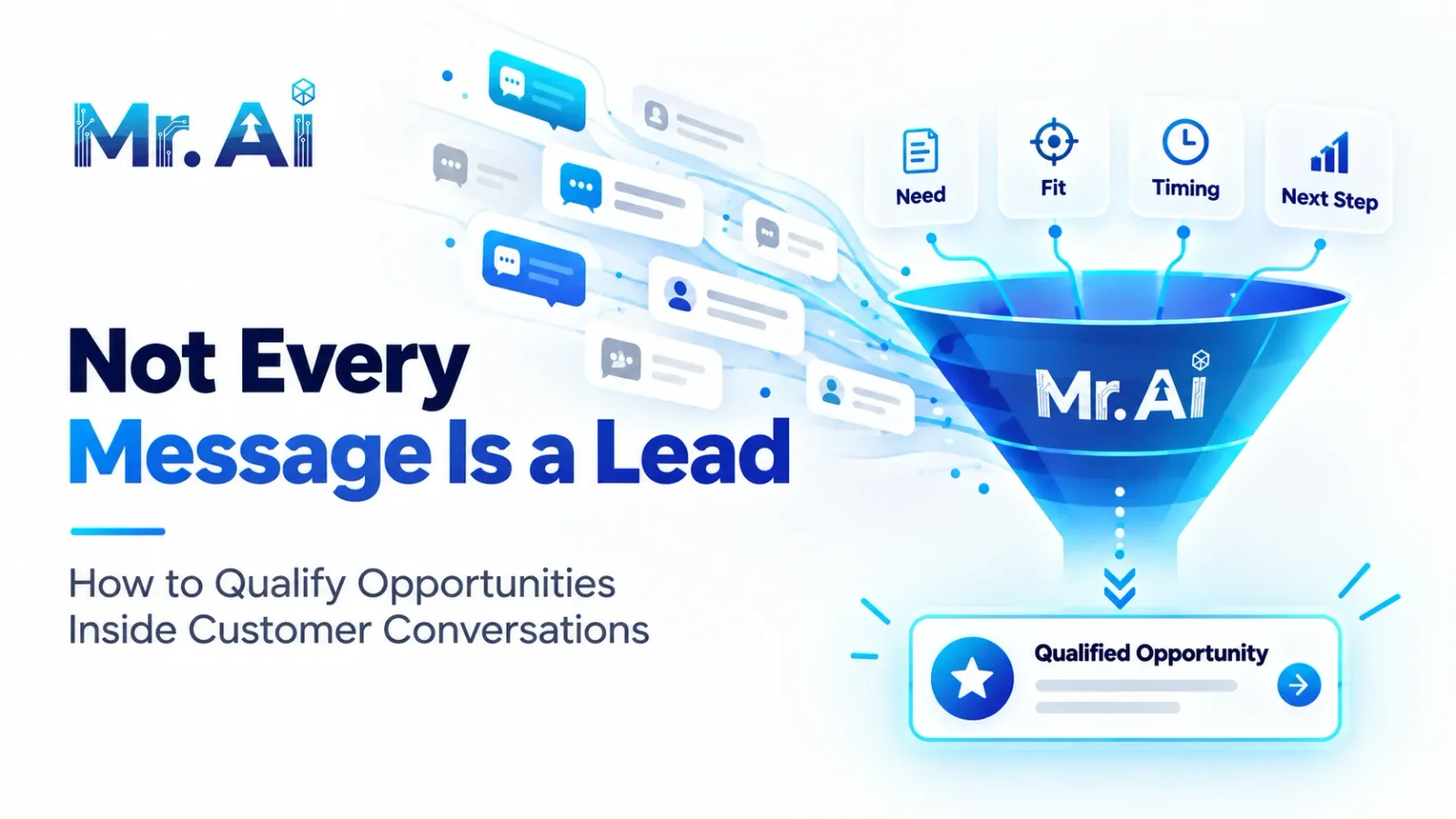
There is no universal qualification framework, but most inbound conversation flows can start with four signals: need, fit, timing, and next step.
A B2B company may also need team size or decision authority. A clinic may need the service and preferred appointment window. An academy may need a student's age and level. Good qualification should mirror the buying decision in your business, not a generic internet template.
Sales attention is already scarce
Salesforce’s seventh State of Sales report surveyed 4,050 sales professionals in 22 countries. Respondents spend an average of 40% of their time selling, with the rest distributed across work such as planning, data entry and training. These are global findings, not a benchmark for Egyptian sales teams or a promised result for your business.
Source: Salesforce State of Sales, 7th edition
Those are global figures, not Egyptian benchmarks. But they expose the operating problem: every minute spent manually triaging a conversation is a minute taken from an already limited selling window.
Meta lists qualifying incoming leads as a capability of Meta Business Agent. In June 2026, Meta said more than one million businesses were already using a Business Agent on WhatsApp and Messenger, while people had more than one billion active daily threads with businesses across WhatsApp, Messenger, and Instagram.
Source: Meta Business Agent, June 2026
None of that proves AI will lift your sales by a specific percentage. It does show that qualification inside messaging is becoming a real operating workflow rather than an experimental use case.
Don't turn qualification into an interrogation
The easiest way to ruin this is to withhold useful information until the customer fills in your fields.
If someone asks for a price and gets three data-collection questions before an answer, the business is optimizing its CRM at the customer's expense.
A better rule is simple: answer first when the answer is available, then collect context as the conversation progresses.
Qualification should feel like a company trying to understand the customer, not a customer trying to pass an exam.
A simple queue beats a vague feeling
You do not need an elaborate lead-scoring model to start. Take the last 100 inbound conversations and classify them into a few operational buckets: ready for a sales step, follow up later, information only, not a fit, or existing customer/support.
The score is not truth. It is a prioritization aid, and a human should be able to correct it.
A hypothetical week with 120 conversations
Suppose a business receives 120 new conversations. This is a hypothetical calculation, not a Mr. AI customer result.
After triage, 30 are support requests, 25 are general information requests with no clear buying intent, 40 are reasonable-fit leads that need later follow-up, and 25 have a clear fit and a near-term sales step.
Sales no longer opens a queue of 120 apparently equal conversations. It has 25 priority cases, 40 with an explicit follow-up path, and separate workflows for the rest.
The value is not that "AI closed 25 deals." Nothing here guarantees a deal. The value is that the inbox became actionable.
Where Mr. AI fits
Based on Mr. AI's currently published product information, the platform supports WhatsApp, Facebook Messenger, and website chat. It can reply using company knowledge, support automated follow-up and next-step tracking, create conversation summaries, and hand conversations to the team with context when human judgment is needed.
That makes it useful for organizing parts of a qualification workflow: answering from approved business information, preserving context, following up according to configured rules, and helping the team pick up cases that require a person.
But your definition of a qualified lead must come from your business. You decide what fit means, which questions matter, and where human judgment begins.
If every message currently lands in the same queue, start with one question: What would your salesperson want to know before opening the conversation so they can immediately decide what to do next?
Try the customer experience or book a demo to review your conversation workflow.