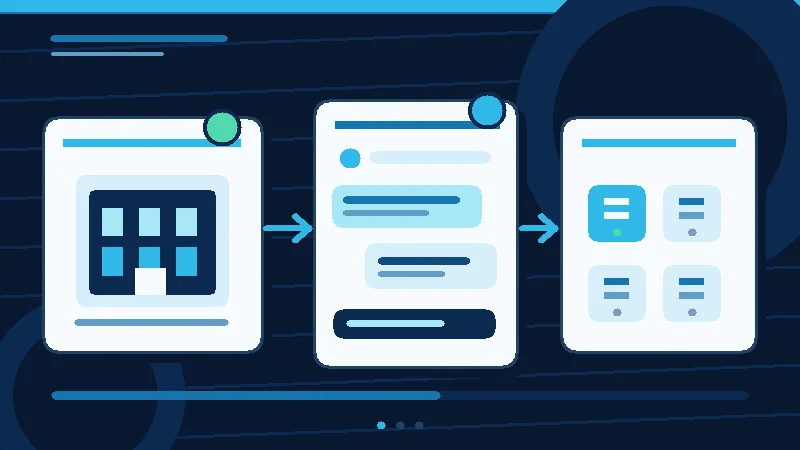
At the end of a support shift, every message may have received a reply while three customer promises remain unfinished. The next team opens the inbox, sees the history and still cannot tell who owns the next action.
The rule: a shift handover transfers accountability, not just conversations. The incoming team needs the last confirmed fact, the customer's expectation, the next action and its due time. A complete transcript without these details is not a reliable handover.
A shift handover is not the same as an AI handoff
An AI-to-human handoff asks whether a case needs human judgment. We cover those triggers in our human handoff guide.
Shift continuity is a different problem. Both agents may be human, yet responsibility changes without an agreement. AI-generated summaries can help provide context, but they do not by themselves assign ownership or ensure acceptance.
Keep one current record for each open case
Before leaving, review unresolved work. Record six fields for each case: case reference, customer request, last verified action, current owner, next action and promised update time. Add a risk or escalation note where needed.
An owner should be a named person or an explicit accountable role, not merely a shared queue. If a case is waiting for a courier or manager approval, record that dependency. Otherwise the incoming team may assume the customer is holding things up.
A practical five-part handover routine
Review exceptions before routine questions
Start with payment issues, sensitive complaints and commitments due before the next shift settles in. This does not mean every case is urgent. It means risk should not disappear among ordinary pricing enquiries.
Write verified facts, not impressions
“Customer upset, please follow up” is weak context. “Customer asked about order reference X; courier delivery is not confirmed; we promised an update after checking with the carrier” gives the next person something actionable.
Name the new owner and obtain acceptance
The incoming team should explicitly acknowledge critical cases. Tagging a colleague or posting in a group does not prove that anyone saw or accepted the task.
Preserve the customer's deadline
Customers do not care when your internal shift ends. If you promised an update at 11 AM, the next team needs the due time and a person responsible for communicating, even if the underlying problem remains unresolved.
Check parallel channels
A customer may message both WhatsApp and Messenger. Review the available context before sending conflicting replies. Do not assume automatic cross-channel identity matching without verifying your tools.
Example: a service business with evening enquiries
A customer requests a new appointment time. The evening agent records the request, but a morning supervisor must confirm availability. A useful handover reads: “Requested Tuesday, not confirmed yet; supervisor checks availability in the morning; customer expects a reply before noon.” A weak handover reads: “Customer wants to reschedule.”
This is a hypothetical workflow, not a client result.
When is a spreadsheet enough?
A small team can begin with a controlled shared register. As channels, branches and pending promises grow, finding the current owner and deadline becomes harder. Evaluate a shared inbox or helpdesk based on the work you actually do. Our Egypt customer service software guide explains the differences.
Define the process before buying software. Can an incoming agent identify unowned cases quickly? Can they see what was promised to the customer?
Measures worth reviewing weekly
Track unowned open cases after handover, missed promised updates, repeated customer explanations and the share of critical cases explicitly accepted by the incoming shift. Sample real conversations as well: a dashboard can hide poor context.
According to the current Mr. AI FAQ, the platform supports conversation summaries, follow-up and human takeover when needed. This is not a claim that Mr. AI includes a shift scheduling module, automatic staffing or guaranteed service-level agreements. Your team defines coverage and escalation rules.
Try a one-week experiment: review five open cases at every shift change and check their owner and next step. If missing conversation context is the recurring issue, try Mr. AI or book a demo to explore an appropriate workflow.
Operational reference: ISO 10002:2018 provides guidance for managing and improving complaint-handling processes. It does not prescribe a universal shift handover template.