Customer conversations are market research that happens every day
Advertising analytics can tell you who clicked or where a visitor left. Customer conversations can add something different: why someone asked, what they misunderstood, which doubts they expressed, and the words they used to describe their need.
That is why analyzing WhatsApp, Messenger and website-chat conversations can help marketing and sales, not only customer service. Done carefully, conversation analysis can inform website content, ads, offers, FAQs and product decisions.
Begin with questions that come up repeatedly
Collect real incoming questions during a defined period and group them into themes such as pricing, product comparisons, availability, setup, shipping or delivery, appointments, payment, refunds, trust and suitability.
Do not count frequency alone. Preserve how customers ask.
"How much?" and "Does this price include everything?" both mention price, but the second may reflect uncertainty about hidden fees.
Capture the voice of the customer without inventing it
Voice of Customer (VoC) is the language and concerns customers actually express, rather than wording a company assumes customers want to hear.
Look for repeated questions such as:
- "I don't understand the difference."
- "Will we need a technical person?"
- "What if the AI doesn't know the answer?"
- "Can I try it before paying?"
These expressions may inspire an ad headline, FAQ, explanation video, landing-page section, demo narrative or sales-objection guide.
Privacy matters. Do not publish identifiable private messages, phone numbers or personal histories without appropriate permission. Use aggregate patterns or anonymized examples.
Find the point where conversations stop
Do not label every conversation that ended as a rejection or prove a cause from timing alone.
Review the last clear interaction: did it end after a price quote, a booking question, a technical concern, a delayed response, a payment request, an unanswered question or a request for a human?
If 30 conversations stop after a similar question, study a representative sample before deciding why. Possible explanations include price, unclear value, unsuitable options or weak responses.
A pattern is a reason to investigate, not proof of causation.
Turn repeated questions into better content
When visitors repeatedly ask the same question, your current pages or ads may not be addressing it early enough.
For example, suppose a SaaS company hears "Will setup be complicated?" throughout its inbox. That question can become a real setup video, a screenshot walkthrough, an article explaining launch prerequisites, a product-page section or a demo showing the first steps.
That is a practical route from support and sales conversations to a marketing content roadmap.
Use objections to improve the offer, not just discounts
"Too expensive" can mean different things:
- The customer cannot see the value.
- They are comparing a different category of tool.
- They worry the product will not work for their situation.
- The budget is not available now.
- They do not need all the features.
- The cost of changing their workflow seems high.
Do not give all these customers the same discount. Categorize the objection and identify what evidence, clarification or option might address it.
Connect source to outcome when the data allows
Useful questions include:
- Which campaign started the conversation?
- What was the first question?
- Was the account a good fit for your ideal customer profile?
- Did the conversation lead to a demo, trial or booking?
- Did the person buy?
- If not, was a specific reason observed or recorded?
This helps distinguish campaigns that generate many messages from campaigns that attract promising customers.
Do not equate reach or message count with commercial impact. Similarly, do not claim a marketing change caused better sales from a dashboard correlation alone.
Build a monthly conversation-insights report
A lightweight monthly review can have seven sections.
Ten most common questions
Show frequency and changes versus the previous month.
Five frequent objections
Add anonymized examples of actual phrasing.
Conversation drop-off points
Mark the recurring steps where exchanges end without clear outcomes.
Company knowledge gaps
Capture questions neither the team nor AI could answer reliably.
Content opportunities
Prioritize FAQs, articles, videos and landing-page fixes.
Product opportunities
Flag recurring requests that suggest a missing feature or workflow.
Sales follow-up opportunities
Identify high-intent cases where the next step has not yet happened.
Assign owners and track which content or product changes the team actually makes.
Where Mr. AI can help
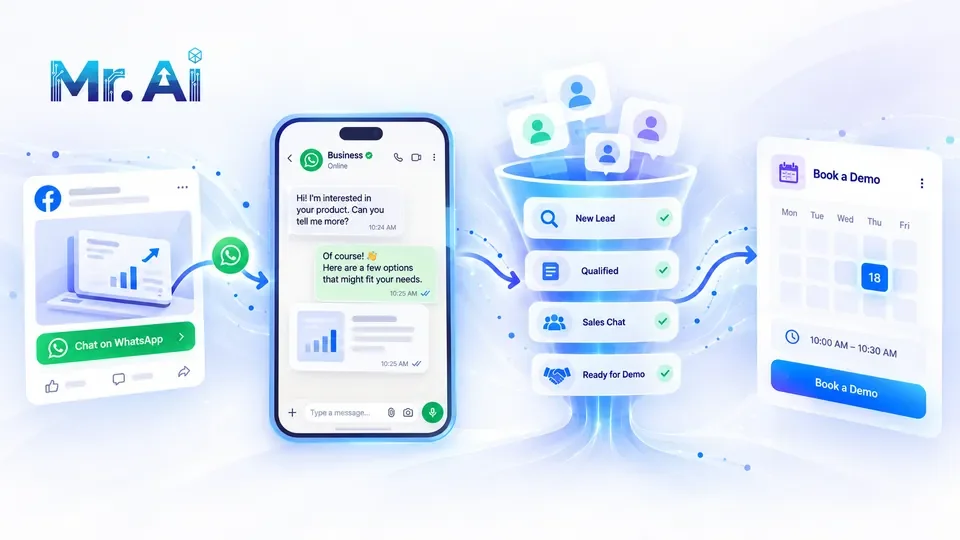
Mr. AI combines customer conversations, company-knowledge-based responses, follow-up, summaries and analytics to help a team see what happens across the customer journey.
The value of conversation analytics is not a magical AI-generated interpretation. It is helping people make a clearer decision from real, reviewable evidence.
For any important conclusion, inspect the source conversations rather than accepting a dashboard at face value.
If your company receives many messages but learns little from them, try the Mr. AI customer experience or book a session to review how conversation insights could support your marketing.