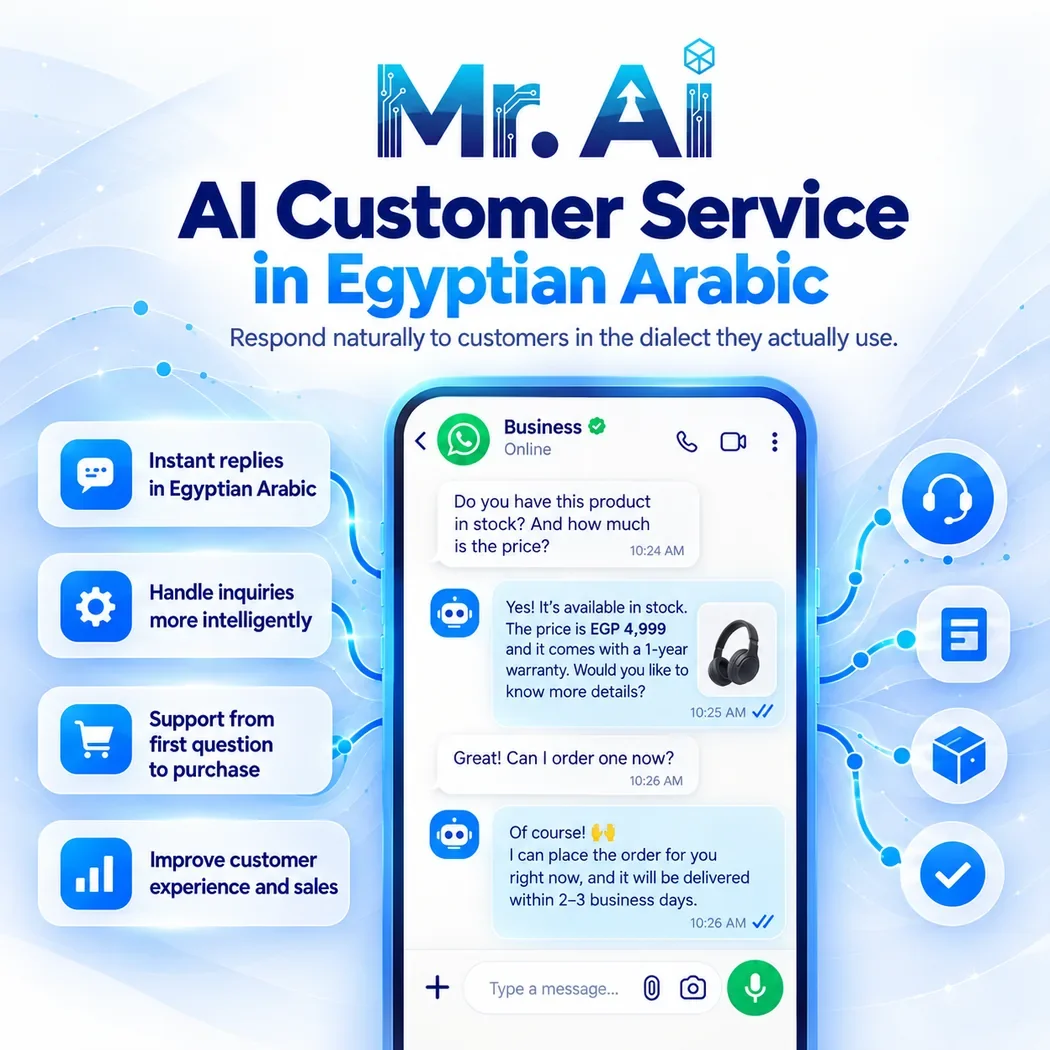
A customer does not care whether your AI “supports Arabic” on a feature checklist. They care whether it understands the Arabic they actually type.
For an Egyptian business, that can mean Egyptian Arabic, Modern Standard Arabic, English, code-switching, spelling mistakes, fragmented messages and Arabizi , sometimes inside the same conversation.
So the useful pre-launch question is not “Does the model speak Arabic?” It is “Can it handle the language patterns in our real inbox?”
Arabic is not one customer-service register
Arabic dialects are not a cosmetic layer over Modern Standard Arabic.
The AraDiCE benchmark, published at COLING 2025, evaluated dialect comprehension and generation and found persistent challenges in dialect identification, generation and translation. The work also highlights how underrepresented dialectal Arabic remains in large-language-model evaluation.
Source: ACL Anthology , AraDiCE
Another 2025 benchmark, Shawarma Chats, created 30,000 grounded six-turn conversations split evenly across Modern Standard, Egyptian and Maghrebi Arabic. Its existence is telling: content-grounded dialogue evaluation across Arabic varieties is still an under-resourced problem.
Source: ACL Anthology , Shawarma Chats
For a buyer evaluating customer-facing AI, that changes the procurement test. A language dropdown is not evidence that the experience works for your customers.
Test the messy messages, not the demo messages
Take a privacy-safe sample of historical conversations and keep the wording close to what customers actually sent.
Include messages such as:
- Egyptian Arabic with shorthand and spelling variation.
- Arabic and English mixed in one turn.
- Arabizi.
- A product name typed incorrectly.
- Three short messages that together form one question.
- A follow-up that only makes sense when the previous turn is remembered.
- A question whose answer is not in the company knowledge base.
If every test prompt is polished MSA, you are evaluating a customer who probably does not exist in your inbox.
Understanding and sounding natural are different tests
A system can correctly understand an Egyptian phrase and still answer in a way that feels oddly formal, over-familiar or culturally misplaced.
Research on culturally grounded figurative language published in 2025 found a measurable gap between understanding expressions and using them pragmatically. Across the evaluated tasks, pragmatic-use accuracy fell 14.07% relative to understanding, while Egyptian idioms proved harder than Arabic proverbs in the study.
Source: Beyond Understanding , arXiv
That is not a customer-service benchmark, and it should not be treated as one. It does illustrate an important distinction for deployment: semantic correctness and conversational fit are separate quality dimensions.
A reply can contain the right price and policy while still sounding wrong for the audience.
Build a small, uncomfortable test set
Thirty to fifty real-world prompts can reveal more than a polished five-question demo.
Cover at least four dimensions:
Language: Egyptian Arabic, simple MSA, English and code-switching.
Messiness: typos, abbreviations, Arabizi and fragmented messages.
Business knowledge: prices, policies, branches, operating hours and exceptions.
Boundaries: missing information, complaints, unauthorized discounts and cases that require human judgment.
Then score each answer separately for intent understanding, factual accuracy, conversational fit and correct escalation. One overall “pass” score hides too much.
A natural dialect does not rescue a wrong fact
An AI agent that sounds perfectly Egyptian but invents a price is not a good customer experience.
Test grounding directly: can each factual statement be traced to approved company information? If a price or policy is missing, the system should explain that it needs review rather than deliver a confident, unsupported answer.
Mr. AI's currently published product information says businesses can provide company knowledge , including services, prices, policies and FAQs , then test questions, review answers and adjust knowledge and rules before relying on them in live conversations. See the current FAQ for the published scope.
That is the useful connection: dialect testing tells you whether the conversation works; grounded company knowledge tells you whether the answer has an authoritative place to come from. Neither removes the need for human review.
Keep the failures
When a customer message needs a human correction, do not just fix that conversation and forget it.
Add the wording to your regression test set. Do the same for misunderstood intent, awkward tone, missing knowledge and incorrect escalation. Re-run those cases after meaningful changes to knowledge or behavior.
A test set that grows from 40 to 55 prompts because real customers exposed edge cases is becoming more valuable, not less tidy.
If you are evaluating Mr. AI, start with the customer experience and bring real, privacy-safe examples from your own inbox. That is a better Arabic test than asking a demo bot three perfect questions.